 ewsba.se
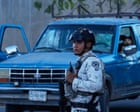
Indictment accuses high-level officials in Sinaloa of offences such as drug trafficking, weapons offences and kidnapping
The US justice department has charged the governor of Sinaloa and nine other current and former Mexican officials for alleged ties to the Sinaloa cartel, accusing them of aiding in the massive importation of illicit narcotics into the United States.
Some officials were members of Mexico’s progressive ruling party, Morena, posing a political conundrum for Mexican president Claudia Sheinbaum as she seeks to offset mounting pressures from the Trump administration.
In her daily press conference on Thursday, Sheinbaum said her government would investigate the allegations – but suggested the motivation behind them might be political.
“We will not cover up for anyone who has committed a crime,” she said. “However, if there is no clear evidence, it is evident that the objective of these charges by the Department of Justice is political.”
The 10 people charged in Manhattan federal court are current and former government or law enforcement officials in Sinaloa, including Rubén Rocha Moya, 76, who has been the governor of Mexico’s Sinaloa state since November 2021.
The indictment alleges the governor was elected in 2021 with the help of the Sinaloa cartel, which allegedly kidnapped and intimidated political rivals in exchange for protection of their operations once in power.
Charges against Rocha Moya included narcotics importation conspiracy and possession of machine guns and destructive devices, along with another conspiracy count. If convicted, he could face life in prison or a mandatory minimum of 40 years behind bars.
Responding to the indictment, Rocha Moya wrote on X that he “categorically and unequivocally reject[s]” the charges, which were “completely untrue and without any basis”.
“It is part of a perverse strategy to violate (Mexico’s) constitutional order, specifically on national sovereignty,” he wrote in a post on X on Wednesday afternoon. “We will show them that this slander doesn’t have any sort of foundation.”
The US ambassador to Mexico, Ronald Johnson, said that combating transnational crime was a shared priority between the US and Mexico.
“Our countries have pledged to strengthen transparency, enforce anti-corruption laws, and uphold the rule of law. That is what our citizens on both sides of the border want and, as I have said repeatedly, this is what they deserve.”
But Sheinbaum questioned Johnson’s comments. “An ambassador cannot have an interventionist attitude,” she said on Thursday.
She added: “We will not allow any foreign government to come and decide the future of the Mexican people.”
Mexico’s attorney general’s office said it would analyse the evidence received from the US to see whether it justified the request that the 10 individuals charged be detained and extradited. It will also start its own parallel investigation.
Sheinbaum said that if the attorney general’s office received or found “compelling and irrefutable evidence”, then the case “must proceed in accordance with the law under our jurisdiction”.
The foreign relations secretariat released a statement saying it had received various extradition requests from the US government, adding that the attorney general’s office would determine whether there was sufficient evidence to detain those charged.
In the indictment, US authorities alleged the defendants played critical roles in helping the cartel ship fentanyl, heroin, cocaine and methamphetamine from Mexico into the US. The Sinaloa cartel is among eight Latin American crime groups designated as terrorist organisations by the US government.
Under pressure from the Trump administration, which has threatened tariffs and unilateral military action, the Mexican government has ramped up its arrests and drug seizures across the country, transferred roughly 100 high-level cartel operatives to US prisons, and launched operations against kingpins.
In the last two months, the Mexican military killed Nemesio Oseguera Cervantes, known as “El Mencho”, the leader of the Jalisco new generation cartel, and arrested Audias Flores Silva, who was a possible successor.
The United States Department of Justice announced on 30 April 2026 that it has filed criminal charges against **Rubén Rocha Moya**, the governor of the Mexican state of Sinaloa, and several other senior Mexican officials for alleged involvement in a large‑scale drug‑trafficking conspiracy.
The indictment, unsealed in the Southern District of New York, accuses the officials of conspiring with the Sinaloa Cartel to transport fentanyl, methamphetamine and heroin across the U.S.–Mexico border. Prosecutors allege that the defendants used their public positions to provide safe‑houses, facilitate money‑laundering, and obstruct law‑enforcement investigations.
- Charges filed: conspiracy to distribute controlled substances, money‑laundering, and obstruction of justice.
- Key alleged actions: authorising the use of state‑owned facilities for drug shipments, directing police to ignore cartel activities, and receiving bribes in the form of cash and luxury assets.
- Potential penalties: each defendant faces up to life imprisonment and forfeiture of assets if convicted.
U.S. Attorney Catherine Miller described the case as “a decisive step in holding foreign public officials accountable for fueling the opioid crisis that has devastated American communities.” She added that the charges demonstrate “the reach of U.S. law when it comes to transnational drug trafficking.”
Mexico’s federal government has condemned the move, calling it “an infringement on Mexico’s sovereignty.” President Claudia Sheinbaum’s office issued a statement urging “a thorough, transparent investigation in Mexico’s courts” and pledging to cooperate with U.S. authorities while defending the nation’s constitutional autonomy.
Political analysts say the indictment could have far‑reaching implications for U.S.–Mexico relations and the internal politics of Sinaloa. The state, long considered a cartel stronghold, has seen a recent push by local officials to attract legitimate investment and improve public security. The charges, if proven, could undermine those efforts and trigger a power vacuum within the cartel’s hierarchy.
Human‑rights groups have warned that targeting elected officials may expose vulnerable communities to retaliation from criminal groups. They called for “robust protection measures for witnesses and community leaders” as the case proceeds.
The indictment follows a series of coordinated operations by U.S. agencies, including the DEA and FBI, aimed at dismantling the transnational networks that supply synthetic opioids to the United States. Earlier in 2026, similar charges were brought against officials in the states of Jalisco and Veracruz, marking an unprecedented legal strategy of pursuing foreign public officials for drug‑related crimes.
The defendants are expected to appear before a federal judge in New York later this month. Their legal teams have indicated they will seek to have the charges dismissed on jurisdictional grounds, arguing that the alleged conduct occurred primarily on Mexican soil.