 ewsba.se
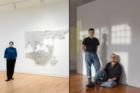
Left: Concept Art Gallery's co-owner and gallery director Alison Brand Oehler standing in the current exhibition, David Muenzer: Exit Interview. Right: april april's co-founders Patrick Bova (left) and Lucas Regazzi (right) Concept Art Gallery: Photo by Sam Pliszka. april april: Photo by Chris Uhren
Since 1896, the Carnegie International has showcased global artistic trends to US audiences, making it the country’s longest-running recurring exhibition. But as the art world helicopters into Pittsburgh for this year’s edition of the show—the largest ever, featuring 61 artists—the city’s handful of commercial galleries and alternative art spaces will in turn showcase the strengths of their own local culture.
Pittsburgh has long maintained a thriving arts scene thanks in part to its legacy of Gilded Age philanthropy and in part to its big-but-not-too-big size, which supports a diverse arts ecosystem while maintaining a friendly atmosphere. The city contains an array of excellent museums such as the Andy Warhol Museum and Mattress Factory, universities such as University of Pittsburgh (with its University Art Gallery) and Carnegie Mellon University (with its forthcoming Institute for Contemporary Art Pittsburgh), nonprofit organisations such as Contemporary Craft and the Pittsburgh Glass Center, and nonprofit galleries such as Silver Eye Center for Photography and Bunker Projects.
However, commercial galleries have been harder to come by. In January, Art Talks at Teutonia held a panel about the city’s commercial galleries, part of a series organised by the Pittsburgh-based collector Evan Mirapaul, who commissioned the extraordinary Troy Hill Art Houses in his own residential neighbourhood. In his panel introduction, Mirapaul explained that Pittsburgh has “amazing institutions, old and new, lots of money, old and new, a huge philanthropic base, old and new, multiple art schools, and a robust community of artists”—then concluded: “The only thing we seem to be short on is a gallery scene.”
There are signs that may be starting to change. Since Covid, several energetic young gallerists, drawing on their industry experiences in New York, Los Angeles and elsewhere, have set up shop in Pittsburgh. The first was Lexi Bishop’s here gallery, which opened in 2020; though the gallery closed in 2023, Bishop remains in the city and this spring will launch Middle Node, a much-needed arts publication and gallery guide for the Great Lakes Basin region. Next was Romance gallery, founded in 2023 by Margaret Kross, a former member of the curatorial team at the Whitney Museum of American Art in New York. Then in 2024 Patrick Bova and Lucas Regazzi relocated april april gallery from Brooklyn to Pittsburgh, inspired by here gallery and by other relationships they developed during their early 2020s studio visits with the Pittsburgh-based artist Paul Peng.
The city’s longer tenured galleries—such as Concept, Zynka and James Gallery—have welcomed these newcomers the way a good restaurant embraces a new one opening next door, confident that a destination street benefits everyone. During the Teutonia panel’s Q&A portion, Alison Oehler, a co-director of Concept gallery, expressed hope that more galleries might establish themselves in the years ahead, maybe even forming a gallery district. Jeff Jarzynka, the founder of Zynka, concurred: “There are too few galleries in Pittsburgh. We have pockets of galleries but if you want to visit them you need to plan [an itinerary] rather than visiting one particular area.”
Installation view of David Muenzer: Exit Interview (until 13 June) at Concept Art Gallery. Background: Goyna (Situation), 2026. Foreground: Coffee in the Office (Exit Interview), 2011/2026 Photo: Sam Pliszka
As the longest-running Pittsburgh gallery, Concept is like the trusted older relative everybody in the family calls for advice. The gallery’s roots go back to 1972, when Mel Berkovitz, a furniture salesman, decided to sell posters as décor; before long, his son and Concept’s present co-director, Sam Berkovitz, shifted the focus to fine art and later expanded into an auction house with a range of complementary services. Today, all aspects reinforce one another, including a gallery programme centred around artists who teach at nearby colleges. Given that Concept often works with estates, Oehler explains that “one of our major roles now is to create context around historic Pittsburgh artists” such as the magical realist painter Henry Koerner (1915-91) and the sculptor Henry Bursztynowicz (1922-2001).
The newest Pittsburgh galleries are also exploring local artistic history as a way to ground their programmes. Romance’s current exhibition, co-curated by Kross and Brittany Reilly, delves into the art and archives of artist Elizabeth “Betty” Rockwell’s pioneering 1940s Pittsburgh gallery, Outlines, which showed work by Joseph Cornell, Maya Deren and John Cage, among others. At next month’s Independent fair in New York, Romance, april april and the Irving and Aaronel deRoy Gruber Foundation (Reilly is the foundation’s executive director) will jointly present a stand of work by another adventurous, under-recognised mid-century woman artist from Pittsburgh, Aaronel deRoy Gruber, whose 1960s and 70s vacuum-formed plexiglass sculptures evince Space Age optimism through their Light and Space aesthetic.
That interest in Pittsburgh’s past derives from the gallerists’ investment in its present. Bova explains that april april’s move away from Brooklyn was “a lifestyle choice as much as a business decision” and “a realisation that in New York we were not living the way we wanted”. Regazzi adds, jokingly: “From a business standpoint, people thought we were crazy.”
Yet the gallery has found its professional footing since the move; its collector base has expanded and its Athens, Georgia-based artist Mo Costello has work in this year’s Whitney Biennial. Bova and Regazzi acknowledge that moving to Pittsburgh may not be right for many gallerists but “it was definitely right for us”. The transition was made easier by the fact that “we were building community here far in advance of our move” and that, even as they have become more established, they “continue to honour and learn from everything that’s already built here”.
Installation view of the current exhibition at april april, Horizon Synonym (until 3 May), featuring works by Peggy Ahwesh, Mo Costello, Renée Green, Margaret Honda and Lai Yu Tong Photo: Chris Uhren
As april april has put down new roots these past several years, Bova’s and Regazzi’s perspective on art fairs — “an inevitable part of this business” — has evolved. On one hand, with fairs having become such an important sales channel “no matter gallery location”, being based outside an art capital has fewer business downsides than in the past and the upside of lower overhead. On the other hand, “fairs are still an immense financial risk, regardless of where our brick and mortar exists”, says Bova.
The balance they have struck is to be “very selective about the fairs we do” and to “treat fairs like specific exhibition opportunities for our artists” that extend the gallery’s core concerns with peripherality and queer speculation. “Personally, I’m more interested in artwork made by someone who lives in the prairies of Alberta than someone who lives in an art mecca,” Regazzi says. He cites Jimmie Durham’s permanent work at the Plug In Institute of Contemporary Art in Winnipeg, Pole to mark the centre of the world (at Winnipeg) (2010), as a “practice of rearticulating where one looks out from”.
For the galleries, old and new, that look out at the world from Pittsburgh, the city’s affordability and close-knit community are among its greatest strengths. In my conversations with arts-involved residents, a recurring theme was that people show up for one another, even the high-ranking directors and curators. “It’s amazing how welcoming the community here is,” says Oehler. “In New York, the equivalent of those museum folks would be inaccessible.”
As for affordability, substantially lower rent can transform a gallery’s financial equation. What’s more, the exorbitant overhead in art capitals has been linked to 2020s complaints about aesthetic stagnation in the visual arts (such as artist Josh Kline’s much-discussed Winter 2026 October article, “New York Real Estate and the Ruin of American Art”). The latest edition of the Carnegie International (2 May-3 January 2027) will bring fresh eyes to a scene that’s been quietly building under more amenable conditions—and these galleries are ready for them. As Mirapaul put it in his Teutonia introduction: “Creativity thrives where the cost of failure is low.”