 ewsba.se
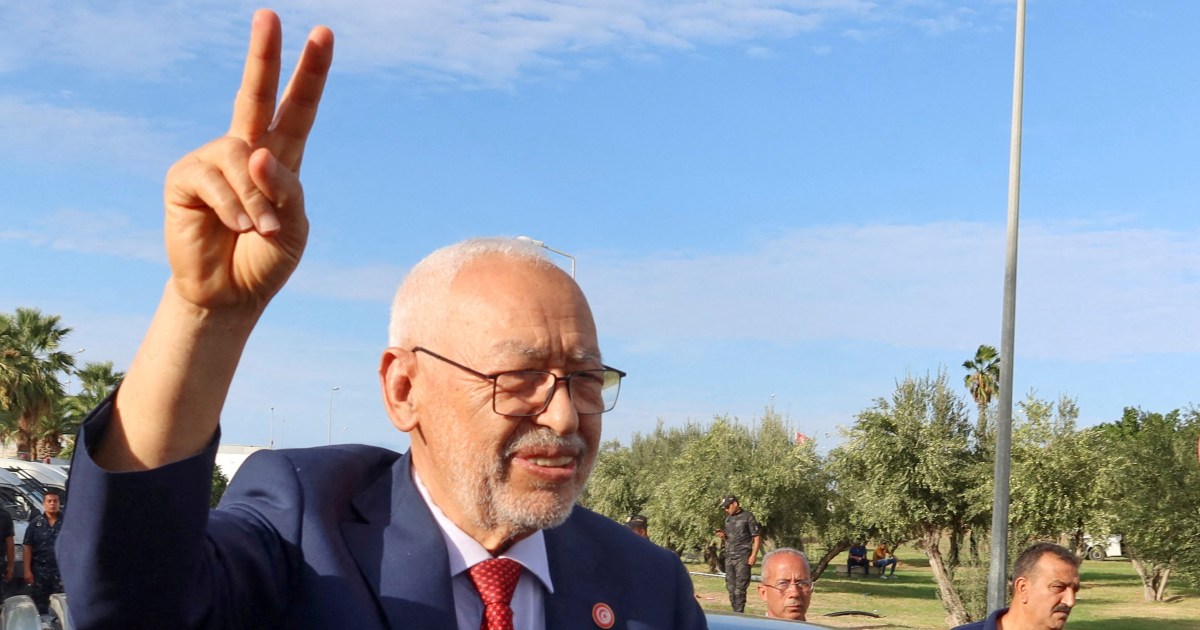
Jailed Tunisian opposition leader Rached Ghannouchi has been rushed to hospital, as his party demands his immediate release.
Jailed Tunisian opposition leader Rached Ghannouchi has been urgently transferred to a hospital after a sharp deterioration in his health, his party has announced, calling for his immediate release.
Ghannouchi, the 84-year-old former speaker of parliament and head of the Ennahdha party, has been imprisoned since April 2023 in what his supporters and international rights groups describe as a politically motivated campaign to crush dissent.
In a statement on Facebook on Thursday, Ennahdha’s media and communications office said prison authorities were forced to transfer Ghannouchi to hospital for treatment and continuous medical observation over the coming days.
The party did not provide specific details regarding his current medical condition, but noted that he suffers from chronic illnesses that require constant family care and attention due to his advanced age.
“In light of this dangerous development, the movement renews its demand for the immediate release of Mr Rached Ghannouchi, considering him arbitrarily detained,” the statement read.
Ennahdha pointed to last year’s decision by a United Nations committee of experts, which concluded that Ghannouchi is being prosecuted for his freedom of opinion and expression, and that the charges against him lack any legal or factual basis.
“The natural place for Mr Rached Ghannouchi is to be free in his home among his family,” the party added, citing his constitutional right to necessary healthcare and international treaties ratified by Tunisia.
Ghannouchi’s hospitalisation is the latest episode in a prolonged crackdown on the political opposition orchestrated by President Kais Saied.
Elected in 2019, Saied – a former law professor – suspended the Tunisian parliament in 2021 and subsequently dissolved the legislature to rule by decree. He later pushed through a controversial referendum on a new constitution that vastly expanded the powers of the presidency. The opposition has described Saied’s move as a coup.
Since then, Saied’s government has targeted numerous opposition figures, journalists, lawyers, and activists. Ghannouchi, the highest-profile figure to be arrested in the consolidation of power, has been held on multiple charges.
He was initially arrested in April 2023 on charges of incitement and sentenced to one year in prison.
In February 2024, a trial court specialising in financial corruption sentenced him to three years in prison over accusations that his party received foreign contributions – a charge Ennahdha vehemently denied.
Furthermore, in February last year, he was handed a 22-year prison sentence on charges that included plotting against state security.
The crackdown has not been limited to Ghannouchi. In November 2025, Jawhar Ben Mbarek, cofounder of the National Salvation Front, was hospitalised due to severe dehydration during a hunger strike protesting his detention.
Shortly after, prominent opposition figure Ayachi Hammami was arrested in December last year to enforce a five-year prison sentence following a mass trial of opposition members.
Human rights organisations, including Human Rights Watch (HRW) and Amnesty International, have consistently condemned the arrests.
In a 2025 report, HRW stated that Tunisia’s government had turned arbitrary detention into a cornerstone of repressive policy.
“Saied’s government has returned the country to an era of political prisoners, robbing Tunisians of hard-won civil liberties,” said Bassam Khawaja, HRW’s deputy Middle East and North Africa director.
Saied, however, has denied accusations of authoritarianism, maintaining that his actions are necessary to fight corruption, rescue the country from political chaos, and hold those he labels as “terrorists” accountable.