 ewsba.se
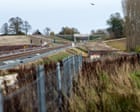
The East West Rail project linking Oxford to Milton Keynes was finished in 2024. There’s just one hitch: no services
The rumbling noise in the night, still enough to waken the unhabituated, is what really goads some people living in Winslow, Buckinghamshire. Freight trains running through the new station since late 2024 prove this stretch of railway is operational. But the long-promised passenger services have yet to appear – and there is no sign of any arriving soon.
Welcome to East West Rail, open or not. For well over a decade, ministers have talked up a new railway linking Oxford to Cambridge via Milton Keynes to accelerate the drive for housing, jobs and growth – an arc of tech industry hailed as the UK’s answer to Silicon Valley.
With the first phase from Oxford to Milton Keynes built, it was highlighted again by the chancellor in January 2025: Rachel Reeves, laying out her economic vision, cited it as the “transport link needed to make the Oxford-Cambridge growth corridor a success”. She looked forward to the start of passenger trains in the coming months, with Chiltern Railways officially taking over in March 2025.
Instead, with little or no explanation, the services failed to run, and the planned start date was shunted to autumn and then the end of 2025. Today, no target for opening is offered at all.
The extraordinary delay has left local MPs and would-be passengers ever more frustrated – not least those living in the new-build homes next to Winslow station, sold on the promise of commuter services via Milton Keynes or Oxford to London.
Callum Anderson, the MP for Buckingham and Bletchley, has been pushing for an answer from his Labour colleagues and campaigning for the line. “It’s unfortunate,” he said. “People can see it and hear it but they can’t use it.” It was, though, “important not to speculate or lay blame at any one door”.
But in the absence of convincing explanations, many people do. A dispute with unions over whether the two-carriage trains require guards is widely believed to be the crucial stumbling block, though the Department for Transport (DfT) and the RMT union deny it is the main reason. Chiltern had planned to start running trains with only a driver, opposed in principle by the RMT and Aslef, the drivers’ union. Many driver-only operations already exist.
A letter from Peter Hendy, the rail minister, to Anderson in March said the primary reason services had not started was that negotiations over contracts with Chiltern were “interrupted by the unexpected general election of July 2024”.
Hendy said trains would need to have been modified and driver training completed, and the new station at Winslow “fully handed over”, but added that “future staffing arrangements also remain to be agreed”.
In a recent statement to the House of Commons, Heidi Alexander, the transport secretary, said Chiltern was “pursuing rolling stock modifications, the completion of the intermediate station, and staffing and training for service introduction”.
The partial explanations, whispers and refusals to give adequate explanations have infuriated those seeking answers.
Diana Blamires is an independent councillor in Winslow, where 4,500 people remain stuck, trainless, halfway between Oxford and Milton Keynes. She has organised petitions and a protest last weekend at Bletchley station, and describes the DfT’s reasoning as “nonsense, pathetic, laughable … How come they could set up a freight train service?”
She said people were angered by the lack of progress. “There’s fury,” she said. “People came to places like Winslow thinking they’d be able to get a train to a job in London, or Milton Keynes or Oxford, or even Bicester. Young people wanted to work at Bicester Village. Now it’s two buses in the morning to get there.
“Rush-hour traffic to Oxford is terrible and it’s extremely expensive to park. People want to get the train and open it up as a place to work. It’s disrupted people’s lives – people move here for jobs and now they are really struggling to get to that job.”
Olly Glover, the Liberal Democrat transport spokesperson and MP for Didcot and Wantage, said any problems with the station were a “red herring” and the election was a “ridiculous” excuse, with the RMT dispute the only possible issue.
“Ultimately the government and the DfT are the ones who made the decision late, they have not resolved this impasse and they have no plan to do so,” Glover said. “They clearly have no plan – and not enough people are holding them to account.
“How are we going to deliver the Oxford-Cambridge growth corridor and all the housing and science facilities, if we have this brand new shiny railway and it’s not open for passengers after a year?”
Compared with, say, the travails and cost overruns of HS2, the story so far of East West Rail is a minor hiccup. But the failure to open even a short and far from ambitious railway – unelectrified and largely running on reclaimed or existing lines – has anguished observers.
The multiple players make accountability more slippery. At the outset is East West Railway Ltd, a private company set up by Chris Grayling, a former transport secretary, 10 years ago so the line could “happen quicker”. The company says it handed the line and station over completed for Network Rail’s sign-off in 2024. “We absolutely understand the frustration that local people in Winslow feel about the delay,” said Natalie Wheble, its external affairs director.
Chiltern Railways has cited unspecified problems with the station. One, according to the RMT, was that an emergency exit backed on to private land – an issue that is understood to have been resolved.
A Network Rail spokesperson said: “We have completed construction works at Winslow station and we are working to support Chiltern as they prepare to operate train services and manage the station.”
A Chiltern Railways spokesperson said it had made “significant progress” and the station was “now in the testing and commissioning phase”, but there was “work still to finish to prepare the trains, on Winslow station and on the operating arrangements for the new route”. They said Chiltern would “provide further updates when we are able to”.
The DfT would only say: “We are supporting Chiltern Railways as they work with unions and other industry partners to get these services up and running as soon as possible. The East West Rail project will unlock thousands of jobs and homes and kickstart hundreds of thousands of pounds of economic growth across England, but we need services to be allowed to start before we can start seeing those benefits.”
Clarification on whom the DfT – which dictated Chiltern’s contract and will soon nationalise its operation – is waiting on for “services to be allowed to start” has yet to be given.
An RMT spokesperson said: “It is simply inaccurate to blame delays to East West Rail on our dispute when the project has been held back for years by indecision, rising costs and unresolved planning issues. The industrial dispute only affects one part of the route and the biggest delays sit squarely with those in charge of managing the project.”
They said the union was opposed to driver-only operation “because it is vital there is a second safety-critical person onboard”, adding that RMT members would “not accept being used as cover for failures in project management”.
The longer story of the Oxford-Cambridge line stretches further into the distance, with yet more consultations ahead for the second and third phases. The development of the Universal Studios theme park in Bedford will bring more passengers – potentially resulting in bigger trains, longer platforms and perhaps another station but delaying construction. The route that finally hits Cambridge is yet to be nailed down, although the latest proposals from East West Rail Ltd are to hasten the building of a station at Tempsford where it crosses the east coast main line, ready for the planned new town.
Hendy’s letter suggested the creation of Great British Railways, including the nationalisation of Chiltern, would “make the process of implementing change on the passenger rail network much simpler in future”. If it does indeed take the advent of GBR to see the government force the line into action, as some locals fear, the wait for a train in Winslow could last some time yet.